



There’s no question that allergies are at an all-time high, with both tree and grass pollen as the top contenders. From Charleston’s coastal winds to lawns being mowed and leaf blowers running every day, you might find yourself avoiding May’s nice weather to hide indoors.
Allergy medicine is one thing, but how can you get to the root of the problem and reduce allergens inside your home?

The short answer
Most homes should change the air filter every 30 to 90 days. Where you land in that range depends on the filter and your house:
- 1-inch fiberglass filters: every 30 days. These are cheap and thin, and they clog fast.
- 1- to 2-inch pleated filters: every 60 to 90 days. The most common type in Charleston homes.
- 4- to 5-inch media filters: every 6 to 12 months. The thick ones that sit in a dedicated cabinet.
Then shorten those intervals if any of this sounds like your house: you have pets, someone has allergies or asthma, you run the system hard (which, around here, is most of the year), or it’s high pollen season. When in doubt, pull the filter and look at it. If it’s gray and matted, it’s overdue.
Here in the Lowcountry, lean toward the shorter end of every range. Our humidity, coastal dust, and brutal pollen seasons load up a filter faster than the package ever assumes.

Why “check the package” isn’t good enough in Charleston
Filter packaging gives you a number printed for an average home in an average climate. Charleston is neither.
We run our AC systems six to eight months a year, sometimes more. That’s a lot of air pulled through a filter that a homeowner in a milder climate would only stress half the year. On top of that, spring layers tree and grass pollen over everything, and our coastal air carries fine dust and salt. All of it ends up in your filter.
So the “every 90 days” guideline on the box? Treat it as a ceiling, not a target. For a lot of homes around here, monthly checks during pollen and peak-cooling season are the honest answer.
How to tell your filter actually needs changing
You don’t have to guess. A few signs that it’s time:
- The hold-it-up-to-the-light test. Pull the filter out and hold it toward a light. If light barely passes through, replace it.
- Dust settling faster than usual. If surfaces get dusty again right after you clean, your filter (or your ductwork) isn’t catching what it should.
- Allergies flaring up indoors. If someone feels worse at home than away from it, a loaded filter is a common culprit.
- The system runs longer to hit the same temperature. A clogged filter chokes airflow, so your AC works harder and your power bill creeps up.
- Visible gray, matted buildup. No test needed at that point. Swap it.

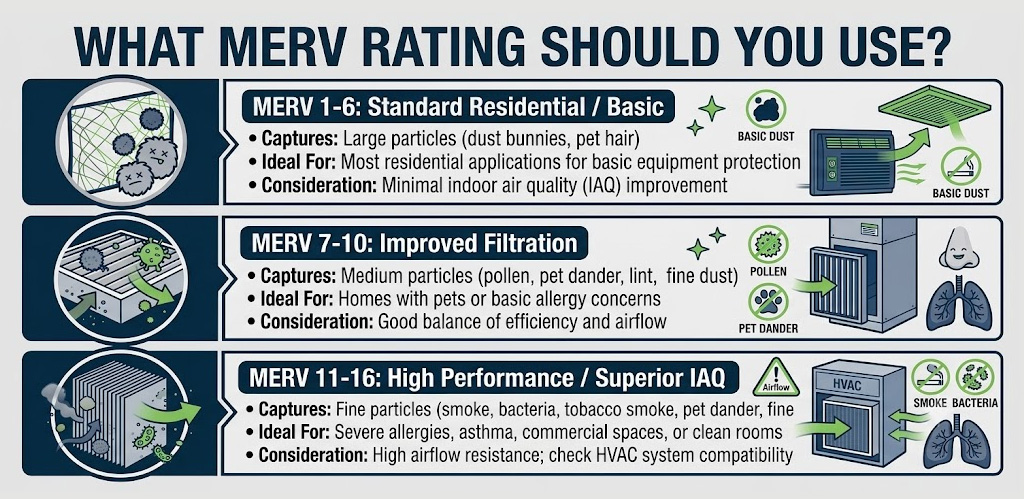
What MERV rating should you use?
MERV measures how much a filter traps — higher numbers catch finer particles. It’s tempting to grab the highest number on the shelf, but that can backfire.
For most homes, a filter in the MERV 8 to 11 range hits the sweet spot: it catches pollen, dust, and pet dander without strangling airflow. Go too high (MERV 13+) on a system that wasn’t designed for it, and you can actually restrict airflow enough to hurt efficiency and strain the blower.
The catch is that “designed for it” varies system to system. Before you jump to a high-MERV or HEPA-style filter, it’s worth asking an HVAC tech what your specific system can handle. We’d rather you run the right filter than the most expensive one.
Does a clean filter really save money?
Yes — modestly, but it’s real. A clogged filter forces the blower to work harder to move air, which uses more electricity and adds wear to the system over time. A clean filter lets your system breathe, so it hits the target temperature faster and shuts off sooner.
Changing a filter is one of the cheapest things you can do for your HVAC system, and skipping it is one of the easier ways to shorten its life. The filter costs a few dollars. A strained blower motor or a premature system replacement does not.
How to change your air filter (the 60-second version)
- Turn the system off at the thermostat.
- Find the filter slot — usually in a return-air grille on a wall or ceiling, or in a slot next to the indoor unit.
- Note the size and the airflow arrow. The size is printed on the cardboard edge of the old filter (something like 16x25x1). The arrow shows which way air flows.
- Slide the old one out, slide the new one in with the arrow pointing toward the unit / away from the return grille.
- Turn the system back on. Done.
Write the date on the edge of the filter with a marker so you know when you last changed it. Future-you will appreciate it.

When the filter isn’t the whole story
A clean filter is step one, not the finish line. Allergens and dust slip past even a good filter over time and settle in your ductwork, out of sight — and then get blown right back into the house. Charleston’s humidity makes this worse, because damp ducts in a hot attic are a comfortable home for mold and mildew.
If you’re changing filters faithfully and still battling dust, musty smells, or allergy symptoms indoors, the issue is usually deeper in the system. A few things that move the needle in Lowcountry homes:
- Duct cleaning and sealing to clear out what’s already settled and stop leaks from pulling attic dust into your air. (Air duct services)
- Whole-home dehumidification to keep indoor humidity under 50%, where mold and dust mites struggle to thrive. (Air quality services)
- Phenomenal Aire air purification, which neutralizes mold spores, bacteria, and allergens as air passes through the ducts. (Phenomenal Aire)

Let your system breathe
Changing your air filter on schedule is the simplest, cheapest habit that protects both your air and your equipment. For most Charleston homes that means every 30 to 90 days depending on the filter — and more often during pollen season or if you’ve got pets or allergies in the house.
If you’d rather not track it yourself, our maintenance plan includes filter checks as part of regular visits, so it’s one less thing on your list.
Have questions about which filter is right for your system, or fighting indoor air problems that a filter alone won’t fix? Call Blanton & Sons at (843) 256-6454 or request a quote. We’ve been keeping Charleston homes comfortable since 1998.
Reviewed by the team at Blanton & Sons — a family-owned HVAC, heating, and plumbing company serving Charleston and the Tri-County area since 1998.